
Traditional fish sauce, and what is worth knowing about it
“Traditional fish sauce” is shorthand for a method of production, used to distinguish it from industrial fish sauce. Here Hai Quyen looks at what traditional fish sauce is, what it is good for, and how to keep it.
In everyday terms, traditional fish sauce is the liquid drawn from fish, shrimp and other sea creatures salted over a long period. It is widely used in the cooking of South-East Asian countries such as Vietnam and Thailand. In scientific terms, fish sauce is a mixture of salt and the amino acids converted from the protein of fish flesh, through hydrolysis driven by enzymes already present in the fish gut together with salt-tolerant anaerobic bacteria. A few basic facts are less widely known:
Anchovy makes the best traditional fish sauce
Almost any small fish can be used. But freshwater fish are not plentiful here, so Vietnam works mainly with small sea fish: round scad, bullet tuna, sea bream, mackerel, anchovy and so on. Experience shows anchovy gives the finest aroma of all.
Anchovy swims near the surface and moves constantly, so it carries little fat. In production no film of fat rises to the top as it does with other fish, and the rancid note you sometimes get is rare. Anchovy also breaks down more completely, so over the same 6–12 months of fermentation the sauce loses the fishy, raw smell that other species leave behind.
Anchovy is the raw material behind the best-known names: traditional Phan Thiet fish sauce, Phu Quoc, Ca Na, Nha Trang and Thanh Hoa.
The first draw is called nuoc mam cot, or mam nhi
The first liquid drawn off is called nuoc mam cot, in some places mam nhi (from the dripping, drop by drop) — a mark of how fine and how prized that first run is.
Under Vietnamese standard TCVN 5107:2003, fish sauce falls into four classes:
- Special grade: over 30 gN/l
- Premium grade: over 25 gN/l
- First grade (over 15 gN/l), second grade (over 10 gN/l)
- Below 10 degrees it cannot be called fish sauce at all, only a dipping sauce.
Thailand requires the two to be labelled separately; in Vietnam the line is less clear, and people distinguish loosely between traditional and industrial fish sauce.
A higher number is not automatically better
When fish are salted, their protein is cut into amino acids of every kind.
- The depth you taste at the back of the throat comes from that mixture of amino acids — organic nitrogen.
- Part of the protein also breaks down into ammonia and ammonium salts, which give the sauce its pungency — inorganic nitrogen.
The two together make up total nitrogen, and that is the figure printed on the bottle. What you actually want when choosing is a high proportion of organic nitrogen, not simply a high total.
Made traditionally, with no intervention, total nitrogen rarely passes 40 gN/l (it varies a little with conditions). Sauces of 50 or 60 degrees generally rely on vacuum concentration.
There are also less safe ways of raising the figure, by adding inorganic nitrogen sources such as urea or MSG.
Judge by both criteria
Traditional fish sauce is salty and full on the tip of the tongue, leaving a sweetness at the back. That sweetness comes from amino nitrogen — fish protein broken down entirely by natural means — not the flat, front-of-the-tongue sweetness of the flavour enhancers in a blended sauce.
Traditional sauce also has an aroma of its own.
On ingredients, traditional fish sauce contains only fish and salt, with no preservatives: the saturated salt and the protein content preserve it naturally. Industrial fish sauce can list more than twenty ingredients, typically flavour enhancers (621 – MSG, 631 and 627 – the “super” enhancers) for an artificial sweetness, plus preservatives to stop it spoiling.
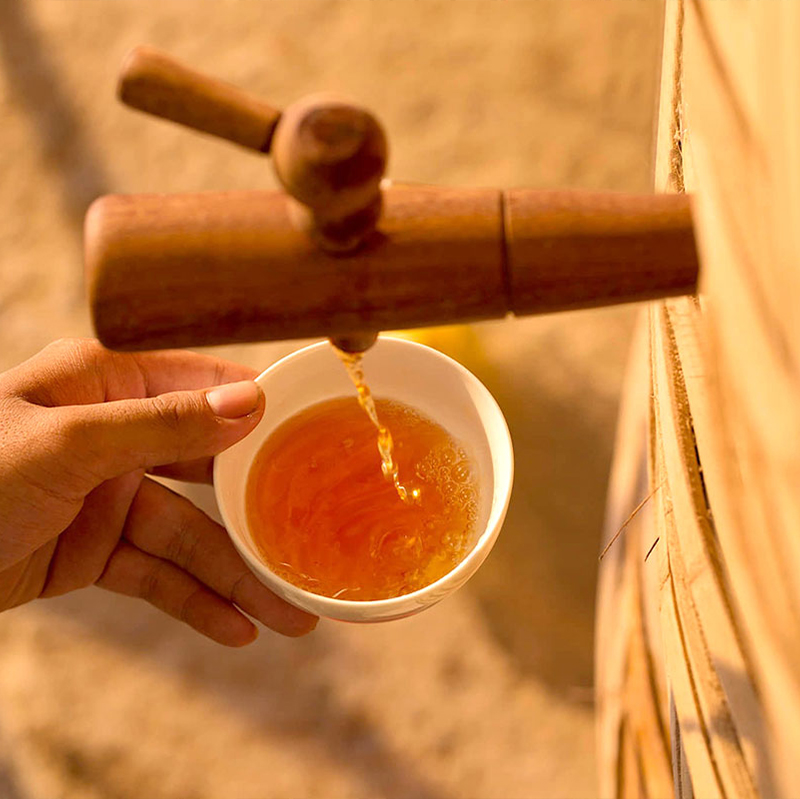
Traditional sauce has a fine amber colour
People who see the bright reddish-amber of traditional fish sauce sometimes assume it has been blended or artificially coloured. In fact the colour comes from being fermented properly: fresh anchovy, coarse salt that has been kept for a long time, and wooden vats packed by the traditional pressing method. Fresh fish, with plenty of blood, give that handsome amber.
For a fine sauce the vats should be made of boi loi wood, which lets fermentation and the breakdown of the fish happen naturally and gives the sauce its natural colour.
Sauce made by stirring, from fish that is no longer fresh, mixed with other species, or fermented in a hurry, tends to come out dark green or near black. A pale yellow sauce is likely blended or industrial.
The arsenic in traditional sauce is not a worry
Traditional fish sauce is made from seafood, which naturally contains arsenic; the higher the protein content, the more of it there is. Arsenic exists in two forms, inorganic and organic. What is present in traditional fish sauce is organic arsenic, occurring in nature, and it poses no real risk to health. Inorganic arsenic is the harmful one.
Salt settling in the bottle is normal
Fish sauce is made by fermenting fish and salt at a ratio of three to one. The saturated salt holds off the bacteria of spoilage and yields a sauce with a clean, gentle aroma. It also keeps the amino acids from oxidising and makes it impossible for any bacteria to take hold.
At that level of salt, sediment sometimes settles at the bottom of the bottle. This can happen when the weather changes, particularly in winter or in a cold store, or when a bottle has stood a long time without being turned or shaken.
It is entirely normal. A gentle shake dissolves it, and it does not affect the quality of the sauce.
Do not keep it in the fridge
In a refrigerator the salt crystallises and settles to the bottom, leaving the upper part without enough salt to preserve the amino nitrogen. The sauce then darkens and the amino acids break down.
During a northern Vietnamese winter you may see salt settle at the bottom of the bottle — again, quite normal. A gentle shake will dissolve it completely.
Not every traditional fish sauce is strong-smelling
A good fish sauce has a light, fragrant aroma, a balance of salt and sweetness, and a mellow finish. That is the result of fish protein being broken down into amino acids naturally, over at least a year and sometimes two. Salting this way lets the fish break down in a saturated salt environment, which holds off the bacteria of spoilage and the off-notes they bring.
A heavy smell usually comes from the stirring method — salt added in several stages — and from fish that is no longer fresh, which lets spoilage bacteria take hold.
Not every salt makes a good sauce
A fine sauce needs coarse, pure salt with an NaCl content above 95%, stored for at least a year before use — the longer the better. Over that time the ions that give a sauce its unwelcome notes (astringency, bitterness, a burn at the throat) drain away, and the result is smoother, sweeter and better.
Add fish sauce to meat only at the end
Do not use fish sauce to marinate meat: it makes the meat tough and dry. Use seasoning powder, salt and sugar for that instead. Nor should you add it at the start of cooking. Put it in a few minutes before you take the pan off the heat. That way you keep both the aroma and the goodness of the sauce.
Add it to soup at the end for a sweeter broth
Fish sauce does belong in soups, where it makes the broth sweeter and fuller. Many cooks use this in place of MSG or stock powder. The trick is to add it and take the pot off the heat straight away. Use only a small spoonful, enough to lift the sweetness without an aroma that takes over the dish. Never let fish sauce boil for long: it turns the soup sour, because the vitamins and nutrients in it break down readily at high temperatures.
A grain of rice floats in good fish sauce
If the grain sinks, the sauce is poor; if it hovers, the sauce has been diluted. When the grain sits flat on the surface, the sauce is good. The explanation is simply density.
Do not treat it as a substitute for meat or fish
Traditional fish sauce contains all the essential amino acids, but its salt content is high (250–300 g/litre), so it cannot serve as a main source of protein.
Suppose you use a 35-degree sauce and get through 50 ml a day. The protein you take in is 50/1000 × 35 = 1.75 g.
A person weighing 50 kg needs 50–70 g of protein a day, so the contribution is genuinely tiny. Nobody can drink fish sauce for protein. What fish sauce is for is flavour.
A change of colour is normal
This is normal in a pure traditional fish sauce made without colour retention agents or preservatives. On contact with air its compounds — the amino nitrogen above all — oxidise. It does not affect quality. To slow it down, close the cap firmly after use, and buy a bottle small enough that it does not stand open for months.
Source: giadinh.vnexpress.net